Winterizing an Empty Inherited House in Chicagoland
📘 Part of Inheriting a House in Illinois: The Complete Guide
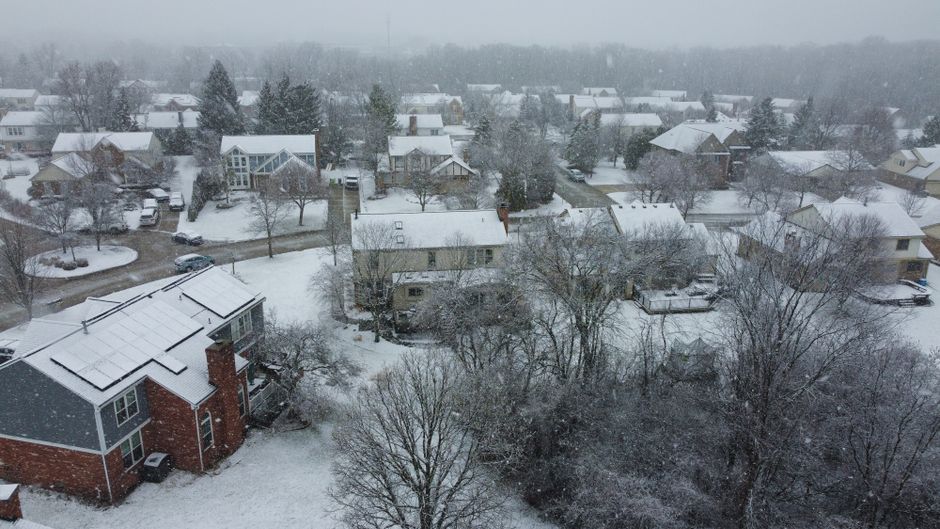
If you are reading this in autumn with a set of keys to a house nobody lives in, you have about six weeks to get ahead of the one problem that ruins more inherited Chicagoland properties than any other.
Not the roof. Not the furnace. A burst pipe.
A supply line that freezes and splits while the house is empty does not make a noise anyone hears. It runs. Families have arrived in March to find ceilings on the floor, hardwood cupped across two levels, and a mold problem that turned a house they could have sold into a house they had to gut. The repair is measured in tens of thousands of dollars. Preventing it is measured in an afternoon and a heating bill.
This guide is the practical checklist. It is not legal, tax or engineering advice — it is what to do before the first hard freeze.
First: decide whether the house stays heated
Everything else follows from this one choice, and there are only two honest answers.
Option A — keep the heat on. This is the right answer for most families, and certainly for any house that might be shown to a buyer, still holds belongings, or has a finished basement. Set the thermostat well above freezing rather than at the lowest setting that feels responsible. The temperature that matters is not the one in the hallway; it is the one inside an exterior wall where a supply line runs, and that is always colder.
Option B — drain the system properly. If the house will sit untouched for months and nobody can check on it, a full winterization by a plumber — water off at the main, lines drained and blown out, traps and toilets protected with antifreeze rated for plumbing, water heater drained, boiler handled correctly — removes the risk rather than managing it. This is a real trade, done properly, not a YouTube afternoon. Get it done by someone who will stand behind it.
What does not work is the middle: heat turned down to almost nothing, water still in the pipes, nobody visiting. That is the exact configuration that produces the March phone call.
If the heat stays on
- Keep the gas and electric accounts active and paid. Transfer them into the estate's name rather than letting a shutoff notice arrive for a deceased person. A furnace with no gas is a decoration.
- Service the furnace before you need it. New filter, a look at the burner and the flue. An unserviced furnace in an unoccupied house is the second-most-expensive failure on this list. The U.S. Fire Administration's heating-safety guidance is a short, sensible read.
- Open interior doors — including the cabinet doors under kitchen and bathroom sinks on exterior walls — so heated air reaches the plumbing.
- Deal with the obvious cold spots. Uninsulated crawl space, an unheated utility room, a laundry line in a back porch addition. Insulate the exposed runs, or shut off and drain just that branch.
- Shut off and drain the outdoor spigots, and disconnect every hose. Frost-free sill cocks still split when a hose is left attached.
- Consider a monitor. A cellular or Wi-Fi temperature sensor that texts you when the house drops below a threshold costs very little and turns an invisible failure into a phone alert. If the house keeps its internet connection, this is the highest-value item on the page.
Water: the decision most families get wrong
Even with the heat on, consider shutting the water off at the main and draining down the lines. A house nobody is living in has no reason to hold pressurized water. If a line lets go anyway — a failed washing-machine hose, a cracked fitting — a closed main turns a flood into a puddle.
Find the main shutoff now, while it is light out and the furnace is running, not in January by flashlight. It is usually in the basement near the front foundation wall, at the meter.
Two Chicago-specific notes. First, if the property is in the city and a sale is coming, the water account has to be settled before the transfer closes, so it is worth pulling the account status early — the Chicago Department of Water Management handles those accounts. Second, do not simply stop paying a water bill to make an empty house cheaper. Unpaid municipal utility balances attach to the property and reappear at closing.
Outside the house
- Clear the gutters and downspouts. Blocked gutters are how ice dams form, and ice dams are how water gets behind a soffit and into a wall.
- Arrange snow removal. Not only because an unshoveled walk is a liability and, in many municipalities, a violation — but because an unshoveled walk after every neighbor has shoveled theirs advertises that the house is empty.
- Trim the branch that overhangs the roof before it comes down under ice.
- Check that the roof, flashing and chimney cap are sound, from the ground with binoculars if nothing else. Winter finds every gap.
- Make the place look occupied. Stop or forward the mail, cancel the papers, put an interior light on a timer, keep the lawn and leaves cleared in the shoulder seasons.
Security, and the check-in schedule
Change the locks. You will rarely know who has a key — a neighbor, a cleaner, a contractor, a former tenant of the coach house.
Then set a schedule and keep a log. Someone walks the house on a regular rhythm, checks the thermostat reading, looks at the ceilings for stains, runs the taps if the water is on, and writes the date down. A written log matters for two reasons: it catches a slow leak while it is still small, and if you have arranged a vacancy endorsement on the insurance, periodic checks are often part of what the carrier expects. Our guide to vacant home insurance after a death explains why that endorsement matters.
If no family member is within driving distance, hire it out. A property-preservation service, a handyman on a monthly retainer, a neighbor who is glad of the arrangement. The cost of a monthly check-in is small compared to the alternative, and the federal winter weather preparedness guidance is a useful framework for what an empty building needs before a storm.
The short version, if you only have one afternoon
- Confirm the gas and electric are on and in the estate's name
- Set the thermostat to a real temperature, not a token one
- Disconnect the hoses and drain the outdoor spigots
- Shut the water at the main and drain the lines, unless someone is there regularly
- Change the locks
- Clear the gutters
- Arrange snow removal and mail handling
- Call the insurance carrier about the vacancy
- Put one person's name on the check-in schedule
Frequently asked questions
Can we just turn everything off to save money?
Turning everything off without draining the plumbing is the most expensive saving available. Either keep heat in the house or have it properly winterized — there is no cheap third option.
What temperature should the thermostat be set to?
Higher than you think. Follow your furnace manufacturer's and your plumber's guidance rather than a number from an article, and remember that the temperature inside an exterior wall is well below the one on the thermostat.
Who pays for all this?
Ordinarily the estate, as an expense of preserving estate property. Keep every receipt. If you are advancing money personally, document it — reimbursement of legitimate expenses is a normal part of administration, and the paper trail is what makes it straightforward.
The house is going on the market anyway. Is this worth it?
Especially then. A winter listing that suffers water damage comes off the market, and what returns in spring is a repair project rather than a home. Our guide to selling an inherited house in Illinois covers the wider timing question.
Nobody in the family lives in Illinois. What then?
Then hire the check-ins and put a temperature monitor in the basement. Distance is a reason to spend a little money on eyes and alerts, not a reason to hope.
What if the pipes have already burst?
Water off at the main first, power off to any affected circuits, then the insurance carrier, then a mitigation company. Photograph everything before anyone starts removing material.
Where we fit
Sell My Inherited Home coordinates the practical side of an inherited Chicagoland property for families who are not nearby — the walk-throughs, the utilities, the contractors, the pieces that do not fit into a phone call from another time zone. There is no pressure and no obligation in asking. Most families just want to know that the house will still be there, dry, in March.
Sell My Inherited Home (Probate Professionals of America, LLC) is not a law firm and does not provide legal or tax advice. This article is general educational information about property maintenance. For plumbing, heating or insurance decisions, use a licensed professional.
Related guides
- Small Estate Affidavit Illinois: A Clear Guide for Heirs
- Probate in DuPage County, Illinois: A Plain Guide
- Illinois Small Estate Affidavit: When You Can Skip Probate